Why Dental 3D Imaging Is Broken — And How AI Is Finally Fixing It
A
Admin
Content Writer
April 18, 2026•13 min read
Artificial Intelligence
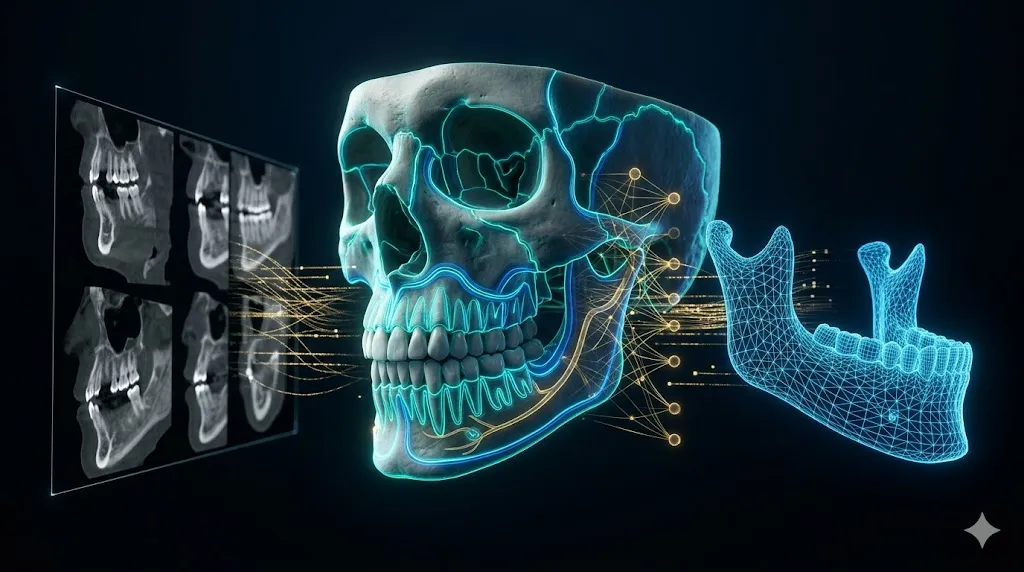
If you run a dental practice, work in a dental laboratory, or plan surgical cases for oral surgery, you already know the frustration. You have a CBCT scan. You need a clean, accurate 3D model. And what stands between those two things is either an enormous software bill, hours of manual work, a cloud platform handling your patient data somewhere you cannot see, or all three at once.
This is not a niche complaint. It is the daily reality for thousands of dental professionals in 2026. And the strange part is that most people in the industry have accepted it as normal — as just the cost of doing business in modern dentistry.
It does not have to be.
The Problem Is Bigger Than Most Clinics Realise
Let's be honest about what the current dental 3D imaging landscape actually looks like for the average practice.
The established platforms — the ones every dental conference and trade show pushes — cost anywhere from $30,000 to $50,000 just to get started. That is before annual maintenance fees, software licensing renewals, training costs, and the hardware lock-in that comes with most of these systems. A practice that commits to one of these platforms is not making a one-time investment. They are entering a financial relationship that compounds every year.
And what do they get for it?
In most cases, they get powerful hardware paired with software that still requires significant manual input to produce a usable 3D model from a CBCT scan. The segmentation — the process of separating bone structures, individual teeth, and nerve pathways from the raw DICOM data — is still largely a manual task on most legacy platforms. A skilled technician can take anywhere from 30 minutes to several hours on a complex case. In a busy practice or lab handling dozens of cases per week, that time adds up to a serious operational bottleneck.
The problem is not that the tools are bad. The problem is that they were built before AI made a better workflow possible — and they have not caught up.
The Cloud Promise That Created New Problems
When cloud-based dental AI platforms entered the market, they looked like the answer. Affordable subscription pricing, no hardware dependency, AI-powered diagnostics accessible from any browser. For smaller practices especially, it seemed like a genuine democratisation of advanced imaging technology.
But cloud-based dental imaging comes with a trade-off that does not always get discussed clearly enough: your patient data leaves your clinic.
Every time a CBCT scan is uploaded to a cloud platform for AI processing, that patient's imaging data is transmitted to and processed on servers outside your control. For practices operating under HIPAA in the United States or GDPR in Europe, this is not a trivial consideration. It requires business associate agreements, careful vendor due diligence, and an ongoing trust that the platform's security posture matches your compliance obligations.
Beyond compliance, there is a practical reality: cloud platforms introduce a dependency on internet connectivity, server availability, and subscription continuity. If the vendor changes pricing, discontinues a feature, or experiences an outage, your workflow stops.
Subscription pricing also has a compounding cost problem. A platform charging $500 per month sounds affordable compared to a $50,000 upfront system. Over five years, that is $30,000 — and you own nothing at the end of it. The software, the data processing, the access — all of it disappears the moment you stop paying.
The Segmentation Gap Nobody Talks About
Here is the specific technical problem that sits at the heart of every dental 3D imaging workflow, and the one that most software — expensive or affordable, cloud or desktop — still has not solved completely.
A useful 3D model for dental surgical planning is not just a render of the jaw. It needs three distinct layers separated cleanly and accurately: the bone structure, the individual teeth, and the nerve pathways. These three elements are what determine whether an implant placement is safe, whether a surgical guide is accurate, and whether a prosthetic design will fit correctly.
Most imaging platforms can handle bone rendering reasonably well. Some can isolate individual teeth with varying degrees of accuracy. Very few can map nerve pathways with clinical-grade precision. And almost none can do all three simultaneously, automatically, and quickly enough to fit inside a real clinical workflow.
This is the segmentation gap. And it is the reason that even practices with expensive imaging setups still find themselves doing manual correction work on their 3D models before a case is ready to plan.
What AI Actually Makes Possible — When It Is Built Right
The phrase "AI-powered" has become so common in dental software marketing that it has almost lost meaning. Every platform claims AI. The question worth asking is: AI trained on what, built for what purpose, and delivering what specific output?
A genuinely AI-native dental imaging tool — one built from the ground up for the DICOM to STL workflow rather than adapted from a general medical imaging model — changes the equation entirely.
When the AI model is trained specifically on tens of thousands of dental CBCT images, it learns the precise anatomical patterns that matter for clinical decision-making. It learns where bone ends and soft tissue begins. It learns the individual morphology of teeth across the full arch. It learns the path of the inferior alveolar nerve and the variations that make certain implant placements risky.
The result is not just a faster version of what technicians were already doing manually. It is a fundamentally more consistent, more reproducible, and more scalable output — one that does not get tired at the end of a long day, does not vary between operators, and does not require years of specialist training to produce.
When that AI runs on a desktop application — locally, without sending data to a cloud server — it also eliminates the compliance and connectivity problems that cloud-based platforms introduce.
This is not a theoretical possibility. This is what DentalAI+ from CosmicSparks IT Services delivers today.
How DentalAI+ Solves Each Problem Specifically
The problems outlined above are not abstract. They are specific, and DentalAI+ addresses each one directly.
The cost problem. Legacy platforms cost $30,000 to $50,000 upfront plus ongoing fees. Cloud subscriptions accumulate into tens of thousands over five years with nothing owned at the end. DentalAI+ is a one-time purchase at $10,999. No subscriptions. No per-scan fees. No annual licensing renewals. The software is yours.
The speed problem. Manual segmentation takes 30 minutes to several hours per case. DentalAI+ processes a DICOM file and delivers a surgical-ready 3D STL model in under 60 seconds. For a practice handling five CBCT cases per week, that is the difference between a half-day of technician time and five minutes of automated processing.
The segmentation gap. Most tools handle one or two layers. DentalAI+ simultaneously detects and separates bone structures, individual teeth, and nerve pathways in a single automated pass. The AI model powering this is a 7.77 million parameter UNet architecture trained on over 40,000 dental images — built specifically for clinical-grade dental segmentation, not adapted from a general-purpose model.
The data privacy problem. DentalAI+ runs entirely on the desktop. Patient DICOM files are processed locally. Nothing is transmitted to an external server. The software operates fully offline, with AES-256 encryption, and is designed to meet HIPAA and GDPR compliance requirements by default — not as an add-on.
The hardware lock-in problem. DentalAI+ works with any DICOM file from any CBCT scanner. There is no proprietary hardware requirement, no ecosystem dependency, and no vendor relationship that ties your imaging workflow to a single manufacturer.
Who This Changes Everything For
General dentists gain the ability to show patients accurate, detailed 3D models of their own anatomy during consultations — improving treatment acceptance without requiring a specialist referral for imaging interpretation.
Oral surgeons get nerve pathway mapping and bone density visualisation that supports safer implant placement decisions, produced in the time it takes to make a coffee.
Prosthodontists can work from accurate 3D models for crown, bridge, and denture planning without waiting for lab technicians to complete manual segmentation.
Dental laboratories can process CBCT cases and produce STL models for 3D printing and CAD/CAM fabrication at a speed and cost that transforms their digital workflow economics.
Dental schools gain a teaching tool that gives students hands-on experience with real AI-driven segmentation workflows — the same technology they will encounter in modern clinical practice.
The Shift That Is Already Happening
The dental imaging market is moving. A report by Insight Ace Analytic projects the dental AI market to grow from $421 million in 2024 to over $3.1 billion by 2034, at a compound annual growth rate of 22.3%. The practices and laboratories that adopt AI-native workflows now are not just saving time and money today — they are building the operational foundation that will define competitive dentistry for the next decade.
The practices that wait are not standing still. They are falling behind.
The question is not whether AI will transform dental imaging. It already has. The question is whether your practice is using a tool that was built for this moment — or one that was built for the decade before it.
Frequently Asked Questions
What makes DentalAI+ different from other AI dental software?
Most AI dental tools are either cloud-based platforms that process data off-site or general imaging software with AI features added on. DentalAI+ is a desktop-first, AI-native application built specifically for the DICOM to STL workflow. It performs simultaneous segmentation of bone, teeth, and nerve pathways in under 60 seconds, runs entirely offline, and is available for a one-time purchase — a combination no other tool in the market currently offers.
Does DentalAI+ require specific CBCT hardware?
No. DentalAI+ works with standard DICOM files from any CBCT scanner. There is no hardware dependency or proprietary equipment requirement.
How does a desktop application handle HIPAA and GDPR compliance?
Because DentalAI+ processes all data locally on the clinic's own machine, patient imaging data is never transmitted to an external server. This removes the primary compliance complexity associated with cloud-based processing. The software uses AES-256 encryption and is designed to align with HIPAA and GDPR requirements by default.
Is the 60-second processing time consistent across complex cases?
DentalAI+ is designed to deliver DICOM to STL conversion in under 60 seconds for standard dental CBCT cases. The UNet model architecture is optimised for speed without compromising segmentation accuracy, achieving clinical-grade precision across bone, tooth, and nerve structures.
What file formats does DentalAI+ support?
DentalAI+ accepts DICOM files (.dcm) as input and exports surgical-ready 3D models in STL format, compatible with standard CAD/CAM platforms, 3D printers, and surgical planning software.
Can dental laboratories use DentalAI+ without a clinical setting?
Yes. DentalAI+ is used by dental laboratories for rapid 3D model prototyping, custom appliance manufacturing, quality verification, and digital workflow optimisation. It does not require a clinical environment to operate.
Dental 3D imaging has been broken for a long time — not because the technology did not exist to fix it, but because the tools being sold to the industry were built around hardware business models rather than clinical workflow needs. AI has changed what is possible. DentalAI+ is what that change looks like in practice.
SEO META TITLE
Why Dental 3D Imaging Is Broken — And How AI Is Fixing It | CosmicSparks
SEO META DESCRIPTION
Manual segmentation, $50K software bills, and cloud data risks are costing dental practices more than they realise. See how AI-powered DentalAI+ solves every problem — in under 60 seconds, offline, at a one-time price.
There's your full second blog — complete CMS block, ready to paste. Same format as the first. Want the Gemini image prompt for this one too?